IPDS Emulation or IPDS Language Conversion:
Technical Guide for Printing Data Streams in IBM Environment
High-Performance IPDS Emulation or IPDS Conversion: Bridging Legacy Data Silos with Modern Enterprise Workflows
In the world of high-volume enterprise printing, Intelligent Printer Data Stream (IPDS) and Advanced Function Presentation (AFP) remain the gold standards for mission-critical document production. However, as organizations modernize, the need to liberate this data from proprietary “silos” and legacy hardware has never been more pressing.
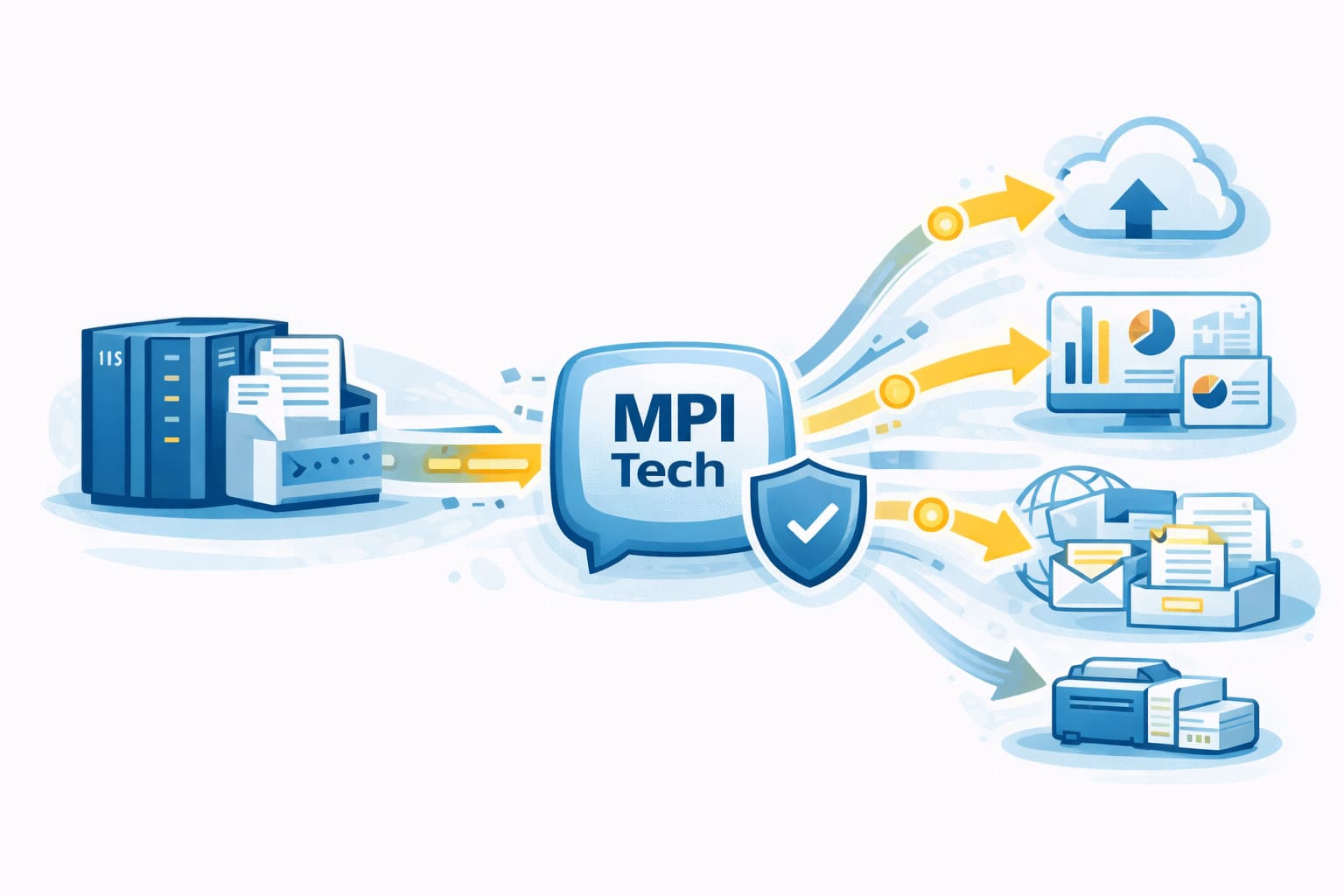
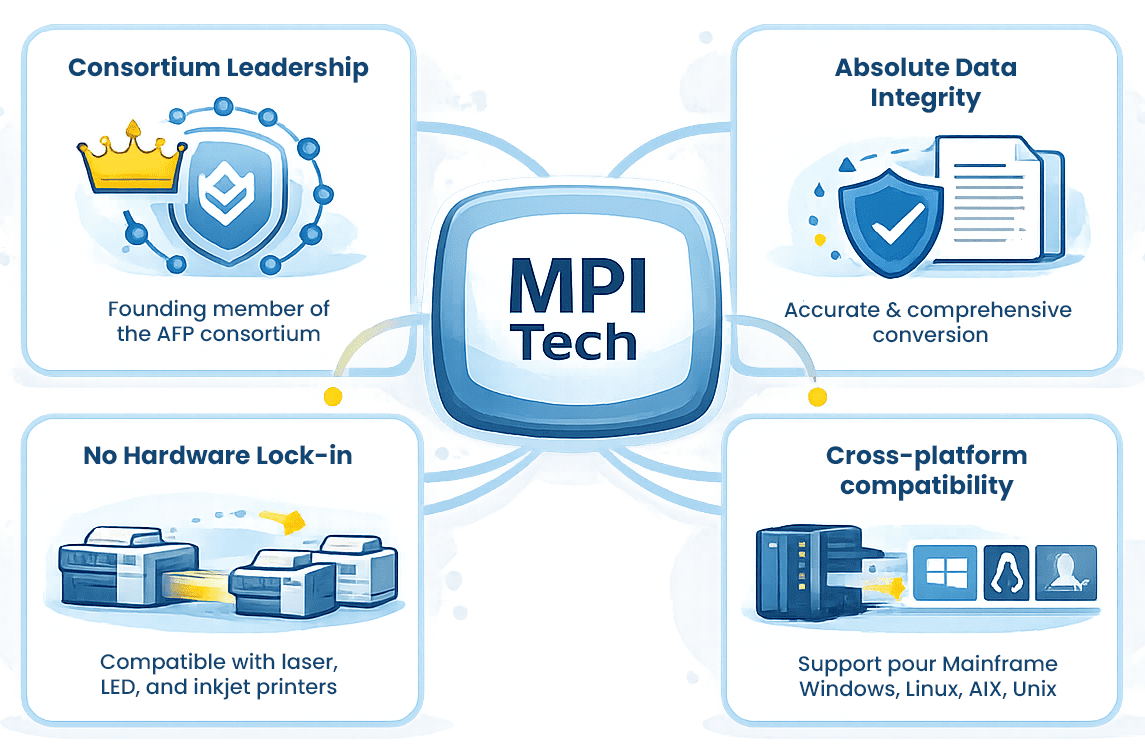
This guide explores the technical foundations of IPDS emulation and IPDS conversion and how MPI’s suite of solutions provides the speed, integrity, and flexibility required for host systems output management.
IPDS is a bidirectional, object-oriented data stream used between host systems (like IBM z/OS or I series) and printers. Unlike simple “fire-and-forget” protocols, IPDS allows for absolute print integrity, where the host receives page-level confirmation that a document has successfully exited the printer.
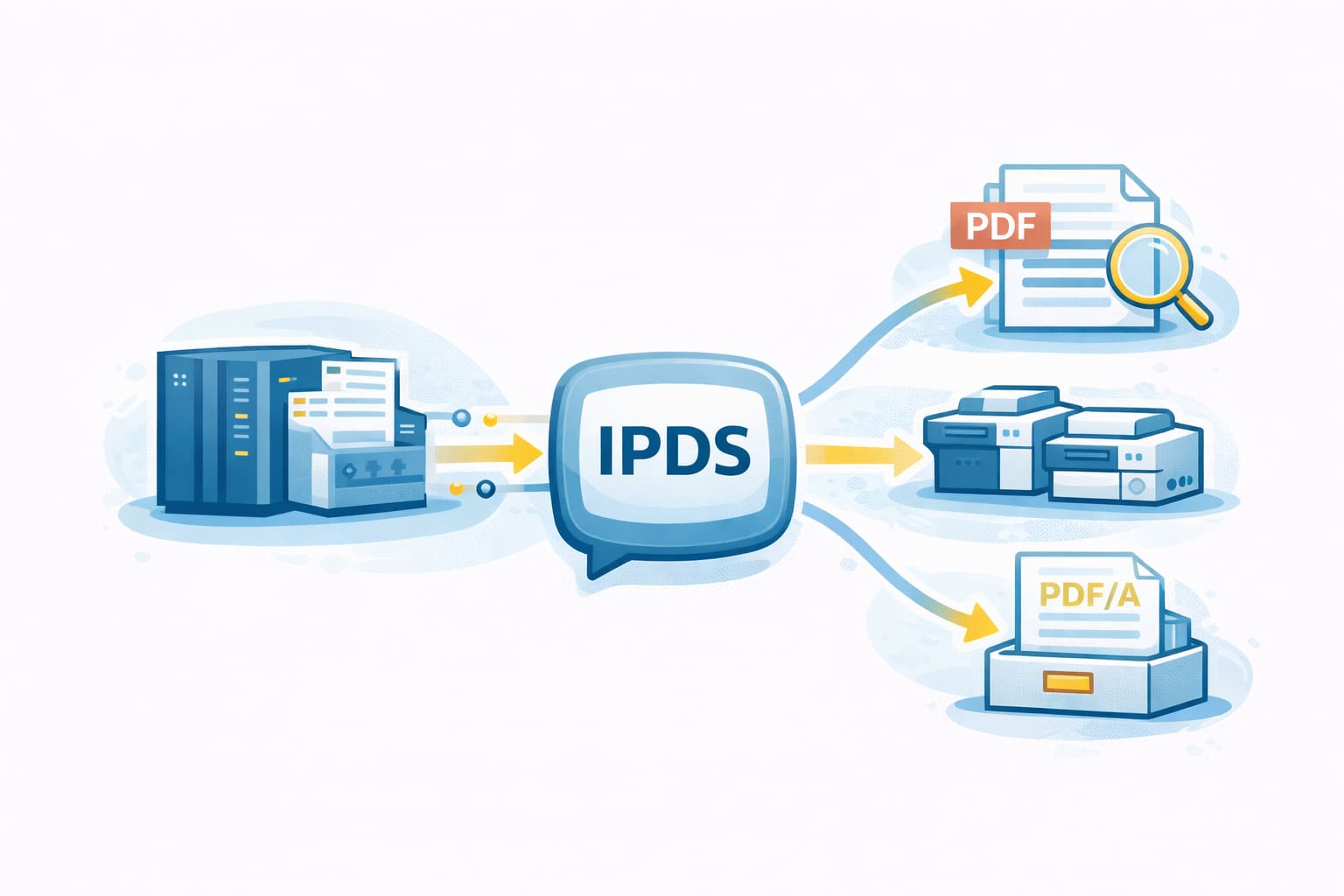
The IPDS language supports printing directly to an IPDS printer or, after conversion, to a standard office printer. However, to integrate this data stream into modern workflows, it must be converted.
In summary, these IPDS streams can:
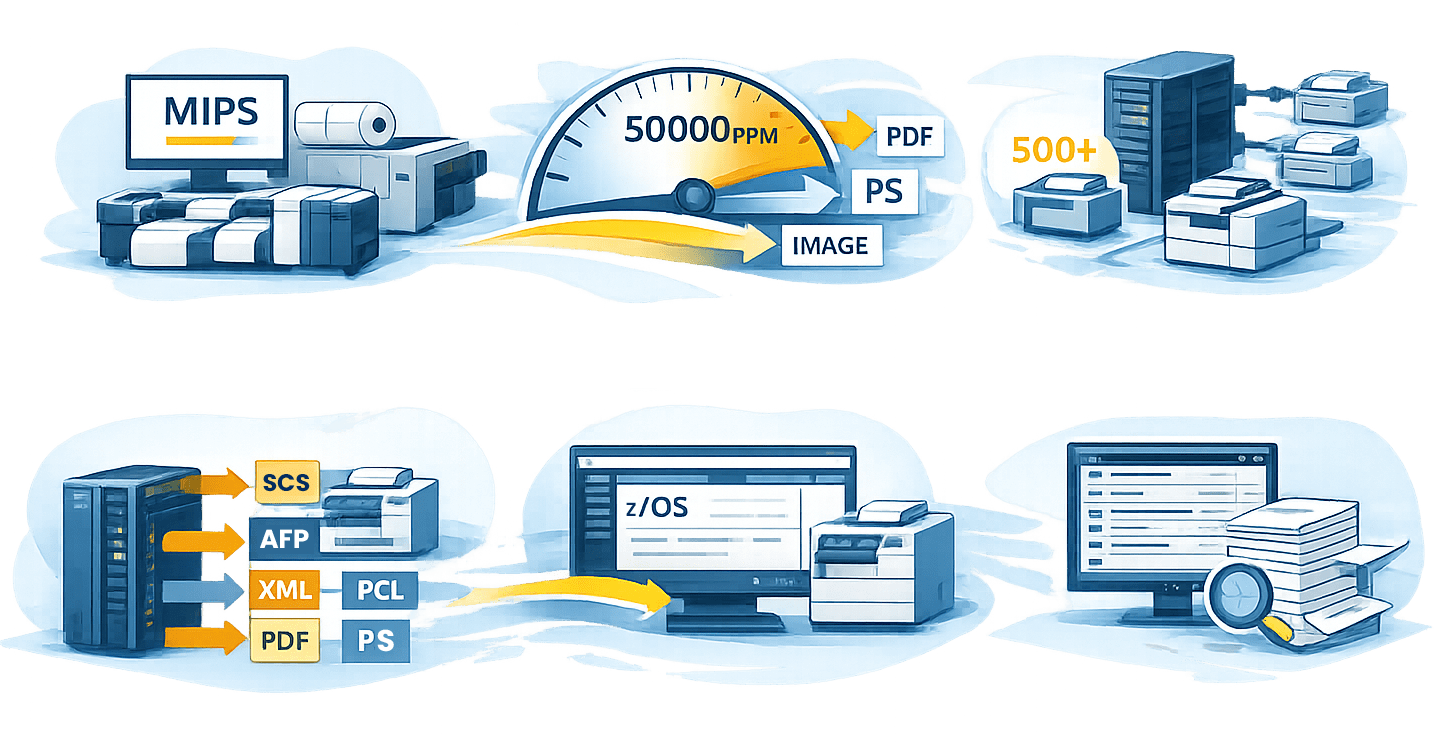
For pure IPDS printing, MPI’s native IPDS emulation software (MIPS – MPI IPDS Portable Software) can be deployed on any type of printer available on the market, whether sheet-fed or continuous-feed. It enables speeds exceeding 6,000 pages per minute (ppm), seamlessly integrating the latest AFP advancements.
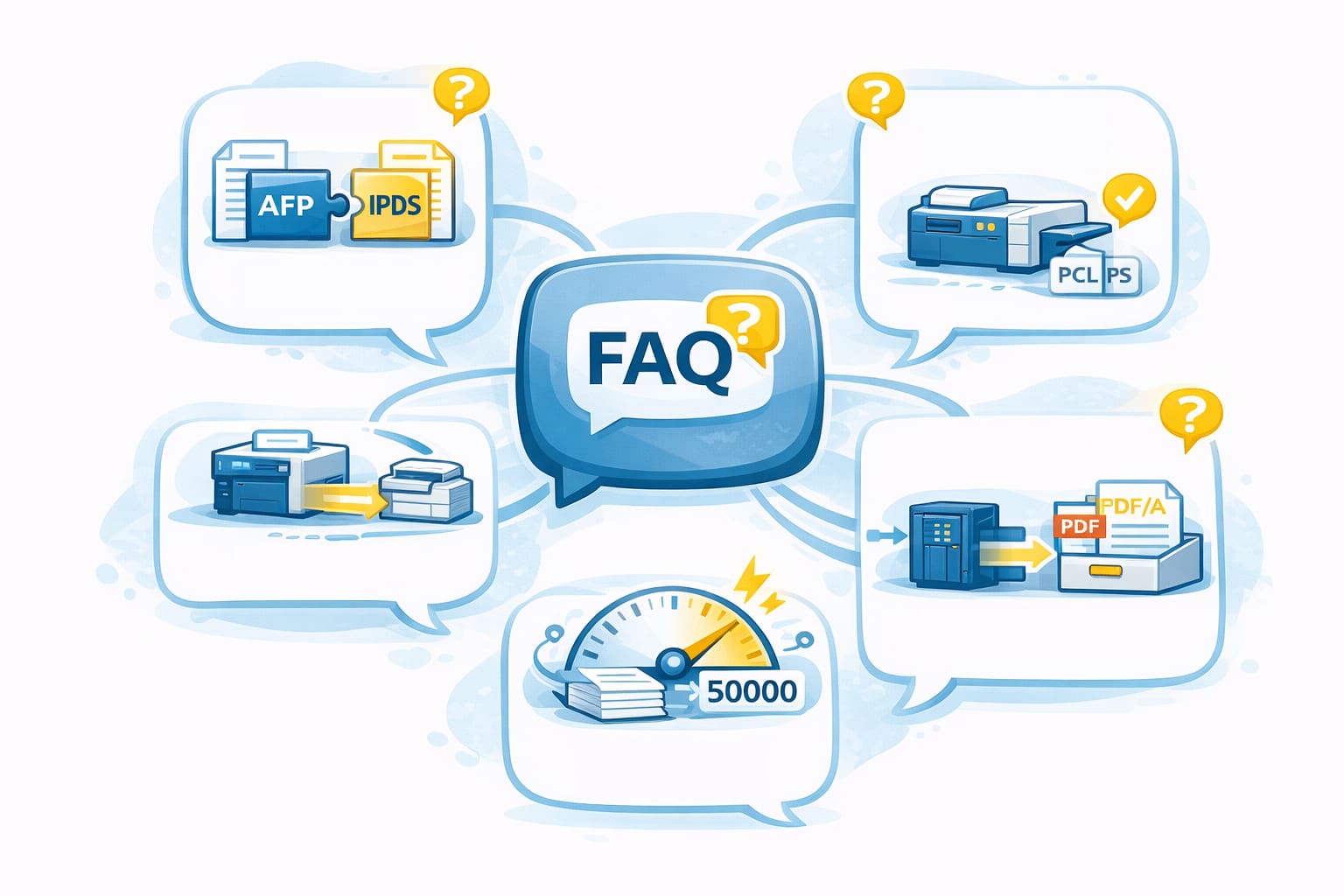
In production environments, speed is a key factor. FastParser was designed for multiprocessor architectures and achieves conversion speeds of over 50,000 pages per minute (ppm). It converts AFPDS and IPDS streams to PDF, PostScript, or various image formats, while supporting the latest AFP Full Color features.
BlueServer or DocOut are solutions that integrate data from IBM systems with modern printer fleets, regardless of the manufacturer.
For organizations wishing to centralize management directly on the mainframe, EPM is a comprehensive software solution for printing on z/OS. It serves as a single point of control for operations and administration, supporting multiple input formats (AFP, XML, SCS) and converting them to PCL, PostScript, or PDF.
Spool2Print is an advanced solution designed for print centers, offering complete control over operations. This software can generate IPDS and thus control IPDS printers. It also includes advanced AFPDS and IPDS conversion capabilities, along with essential error recovery and error messaging features, allowing you to preview, start, pause, or resume jobs as needed.
AFP (Advanced Function Presentation) is a comprehensive architecture and a page description language (PDL) used to define the text and graphics in a document. IPDS (Intelligent Printer Data Stream) is the bidirectional communication protocol used to transmit this data to the printer and send status or error information back to the host system.
Yes.
Installing an IPDS emulation module (such as the HP BlueKit™) or MIPS software directly on the printer makes it immediately IPDS-compatible.
Using a transformation engine such as BlueServer, DocOut, EPM, PSS, or ACM also allows you to convert IPDS streams to PCL, PostScript, and PDF—the languages used by office printers and multifunction devices (MFPs).
Speed depends on the solution used. While standard converters can process a few hundred pages per minute, MPI Tech’s FastParser™ can achieve speeds exceeding 50,000 pages per minute (ppm) thanks to its multi-processor architecture.
Yes.
MPI’s solutions such as the AFP Conversion Module (ACM), EPM, PSS, or BlueServer generate documents in native PDF format, enabling full-text search for optimized distribution and viewing.
PDF/A (specifically the AFP/A ISO 18565:2015 standard) is a subset of the AFP architecture defined for the long-term preservation of documents. It ensures that documents are device-independent and can be accurately retrieved and viewed decades into the future.
No.
MPI’s solutions process data streams from host systems “on the fly,” enabling organizations to modernize their printing infrastructure or transition to electronic distribution without making any changes to existing applications.
To provide the best experiences, we and our partners use technologies like cookies to store and/or access device information. Consenting to these technologies will allow us and our partners to process personal data such as browsing behavior or unique IDs on this site and show (non-) personalized ads. Not consenting or withdrawing consent, may adversely affect certain features and functions.
Click below to consent to the above or make granular choices. Your choices will be applied to this site only. You can change your settings at any time, including withdrawing your consent, by using the toggles on the Cookie Policy, or by clicking on the manage consent button at the bottom of the screen.