


AFP (Advanced Function Presentation) is an enterprise document architecture widely used for the production of critical, high-volume documents. IPDS (Intelligent Printer Data Stream) is the bidirectional data stream used to control document printing.

40 years of AFP & IPDS expertise
What would you like to do with your AFP or IPDS streams?
MIGRATE
Convert a large AFP archive to PDF
Convert very large volumes of AFP documents to PDF or PDF/A for migration, digital archiving, viewing, and long-term accessibility.
Recommended Solution: FastParser™
50 000+ pages/minute*
AFP → PDF / PDF-A
Indexing & Metadata Extraction
TRANSFORM
Modernizing IBM Application Outputs
Retain existing applications while converting their AFP, IPDS, and SCS output for printing, electronic distribution, and archiving.
Recommended solution: BlueServer™
AFP / IPDS / SCS
→
PDF / PDF-A • Printing • Archiving
MANAGE
Managing Production Print Workflows
Centralize spooling, conversion, routing, and management of AFP, IPDS, and other print streams in complex production environments.
Recommended solution: Spool2Print™
Multi-format inputs
Automated Conversion
Print and Digital Output
Print natively via IPDS on compatible HP devices
Add IPDS support to compatible HP printers and MFPs while retaining existing IBM print flows.
Recommended solution: BlueKit™
Native IPDS
Integration with HP Printers
Plug & Play

“AFP is generated by so-called ‘critical’ applications that produce large quantities of variable documents, for example, in sectors such as insurance or banking.”
“These applications must ensure reliable reproduction of prints or their visualization and, above all, complete data integrity.”
– AFP Consortium –

AFP2PDF: Bring historical AFP documents into a modern environment
Preserve your applications. Modernize output workflows.
Not all organizations want to abandon their existing IBM environment.
Sometimes, the need is simpler: to keep the applications that work while modernizing the way their data and documents are processed and distributed.
BlueServer™ receives AFP, IPDS, and SCS data streams and converts them into various formats, including PDF, PDF/A, PCL, and PostScript, for printing, electronic distribution, and archiving.
This opens up new possibilities for existing host applications without requiring a redesign of the application that generates the documents.
One data stream. Multiple destinations.
- AFP / IPDS / SCS →
- PDF & PDF/A (Digital Documents and Archiving)
- PCL / PostScript (Modern Printing Environments)
- Indexed PDF (Archives documentaires interrogeables)
- Electronic Distribution (Modern Document Distribution)


AFP & IPDS in Modern Production Printing Environments:
AFP and IPDS are not just legacy formats. For many organizations, they are still part of active and critical production workflows.
Spool2Print™ centralizes spooling, conversion, and print management in production environments that receive data from multiple platforms and ERP systems.
It can accept formats such as AFP, IPDS, PCL, PostScript, and PDF, and automatically convert jobs to the required output format.
For digital distribution, archiving, and web publishing, Spool2Print can generate PDF and image files at processing speeds exceeding 10,000 pages per minute.
Need to preserve native IPDS printing?
Modernizing does not necessarily mean eliminating IPDS.
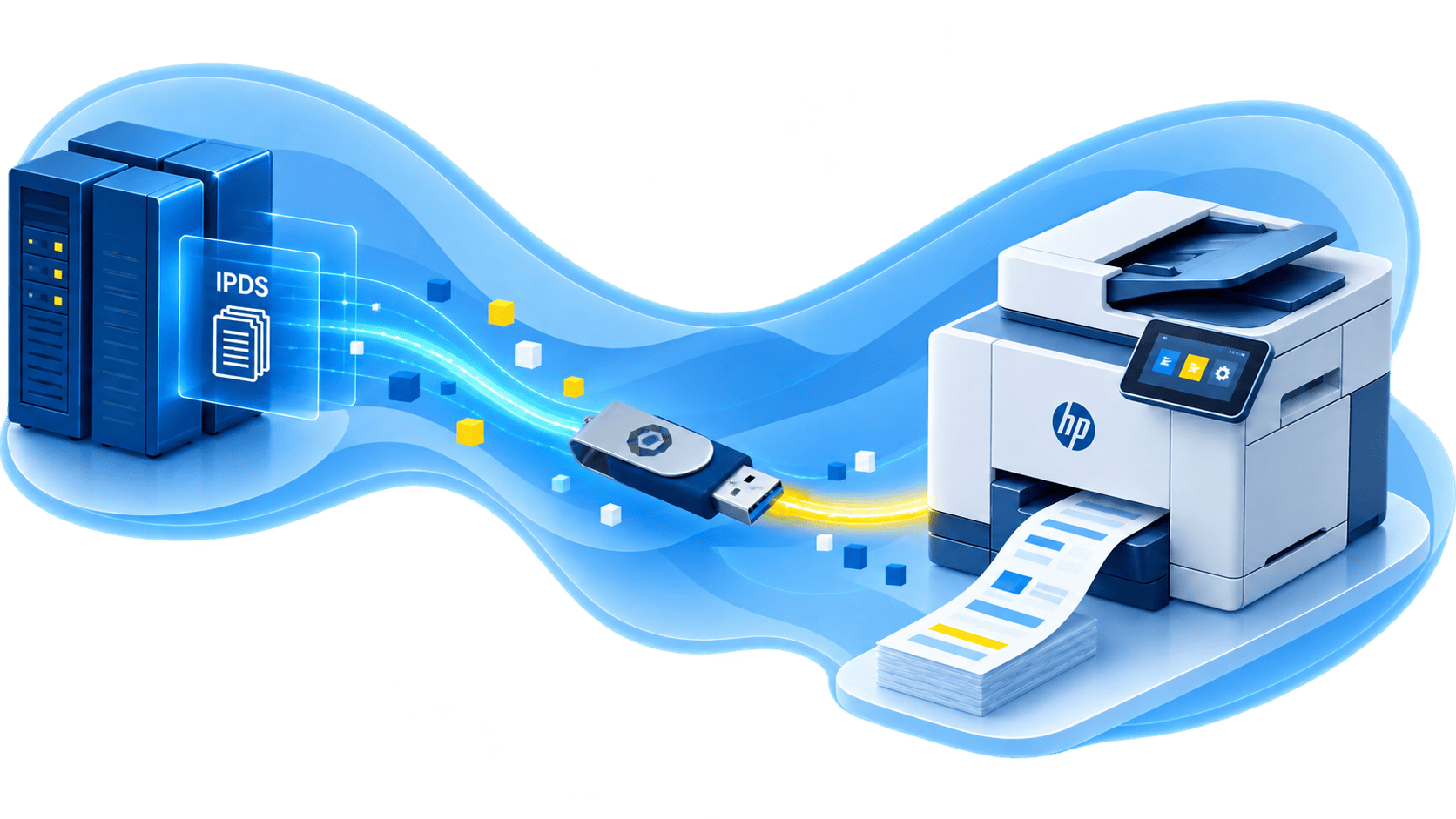
For organizations that need to continue sending IPDS jobs directly to compatible HP printers, BlueKit™ adds IPDS support to compatible HP LaserJet and PageWide printers and MFPs.
Once installed, IPDS becomes an additional native print language, allowing IPDS jobs to be printed directly.
A single technological environment.
Multiple paths to modernization.
ARE YOU MIGRATING FROM A LEGACY SYSTEM?
AFP Archives
↓
FastParser
↓
PDF / PDF-A Archives
ARE YOU KEEPING YOUR EXISTING APPS?
AFP / IPDS / SCS
↓
BlueServer
↓
Printing + PDF + Archiving + Distribution
DO YOU MANAGE A PRINTING OPERATION?
AFP / IPDS / PCL / PS / PDF
↓
Spool2Print
↓
Manage + Convert + Route + Print
DO YOU STILL USE IPDS PRINTING?
IBM Environment
↓
IPDS
↓ BlueKit + Compatible HP equipment
AFP expertise that goes far beyond file conversion
Successfully modernizing an AFP/IPDS environment involves more than simply replacing one file extension with another.
Business documents may contain fonts, overlays, images, graphics, barcodes, indexes, and other resources that must be interpreted correctly to ensure the expected output.
MPI’s expertise spans document conversion, output management, production printing, electronic distribution, and archiving. More broadly, MPI Tech solutions enable the management of physical and digital document workflows throughout the document lifecycle.
Over 40 years of expertise
Document Management, Printing, and Business Workflows
10 000+ clients
Major accounts, government agencies, and small and medium-sized businesses
International Presence
Europe, England, North America, and partners
FAQ: Frequently Asked Questions About AFP & IPDS
What is AFP?
AFP stands for Advanced Function Presentation. It is an enterprise document architecture developed for the structured production of high-volume documents, and is widely used in IBM Mainframe and enterprise printing environments.
What is IPDS?
IPDS (Intelligent Printer Data Stream) is a bidirectional communication protocol used in IBM environments to control printing. It allows the host system to send print data to the device and receive information in return about the job’s status and processing.
What is the difference between AFP and IPDS?
AFP refers to document architecture and its resources, while IPDS is the bidirectional data stream used to communicate information about documents and print control between a host system and an output device.
What is AFP2PDF conversion?
AFP2PDF refers to the conversion of AFP documents into PDF files. Organizations can use AFP2PDF to migrate historical document archives, make older documents accessible through modern systems, enable their electronic distribution, or create digital archives.
Can AFP files be converted to PDF/A for long-term archiving?
Yes. MPI Tech solutions, including FastParser and BlueServer, support conversion from AFP to PDF/A. FastParser is particularly well-suited for high-volume AFP conversion needs.
Can IPDS be converted to PDF?
Yes. MPI Tech offers solutions capable of receiving IPDS streams and generating PDF files. FastParser supports IPDS streams generated by the host for high-speed conversion, while BlueServer supports AFP, IPDS, and SCS conversion as part of broader output workflows.
Which MPI Tech solution should I use to convert a large AFP archive to PDF?
For large-scale AFP archive migration projects, FastParser™ is designed for high-speed conversion from AFP to PDF/PDF-A. Its conversion engine can process over 50,000 pages per minute, depending on the architecture and application.
Which solution should be used for AFP and IPDS printing?
It depends on the environment. BlueServer™ can convert AFP/IPDS streams for modern printing environments and digital workflows; Spool2Print™ is designed for spooling and production print management; and BlueKit™ adds native IPDS functionality to compatible HP devices.
Is it possible to modernize AFP/IPDS workflows without modifying existing applications?
Yes. BlueServer is specifically designed to convert and distribute output from IBM environments while integrating with existing document workflows, without requiring any changes to the applications that generate the data.
Can converted AFP documents be indexed and searched?
Yes. FastParser supports AFP indexing and metadata extraction, while BlueServer can convert AFP/IPDS streams into indexed PDF files for document archiving.
What’s the next step for your AFP/IPDS environment?
Whether you want to convert millions of AFP documents to PDF, modernize your existing IBM workflows, manage production printing, or maintain IPDS printing, MPI Tech can help you identify the best approach.