Electronic payslips
for a public organization
Digitization of payslips


Modernizing Payroll Distribution in the public sector
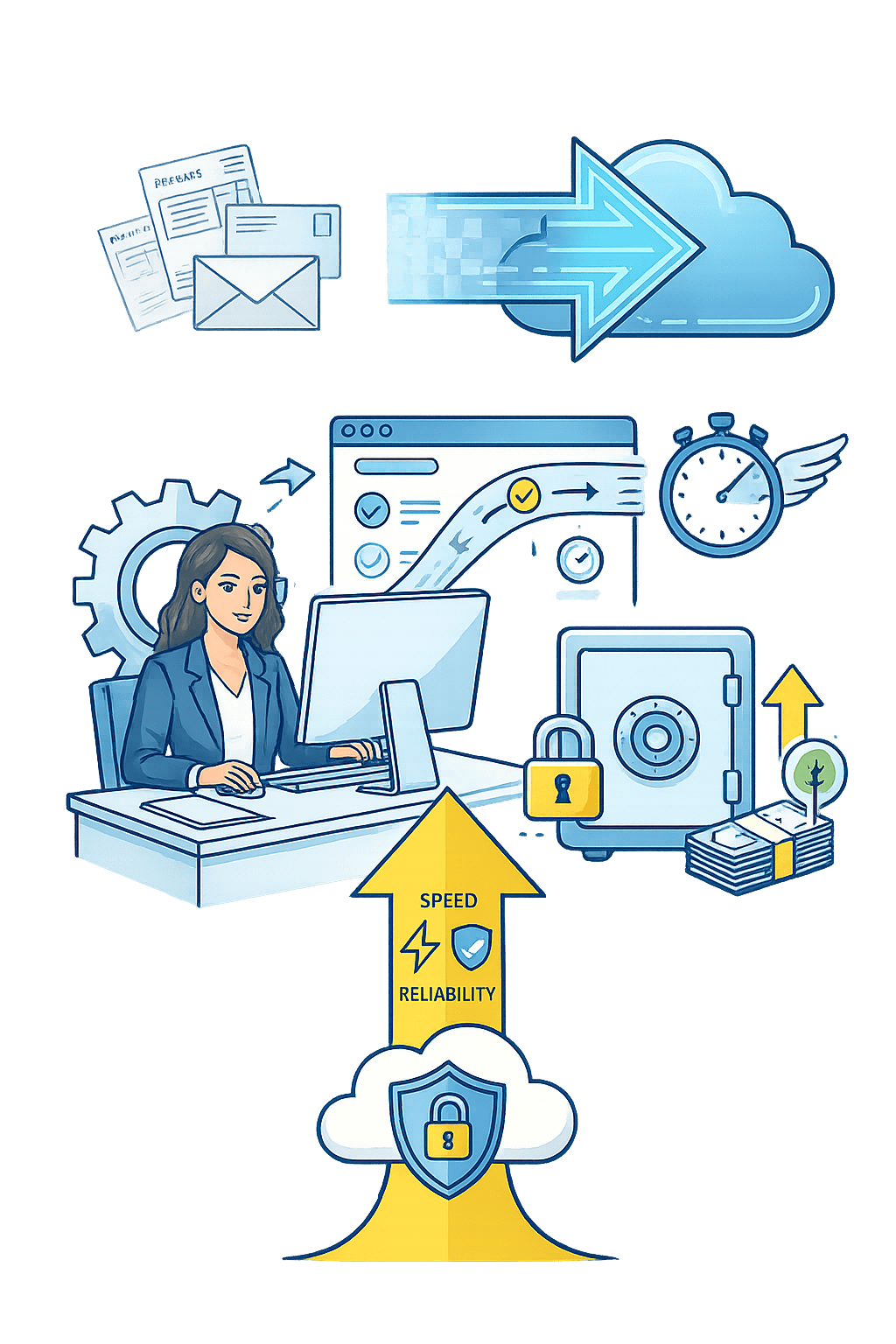
According to the General Director of Public Finance in France (DGFiP), the transition to electronic pay stubs can reduce costs associated with printing and distributing paper documents in public organizations by up to 70%.
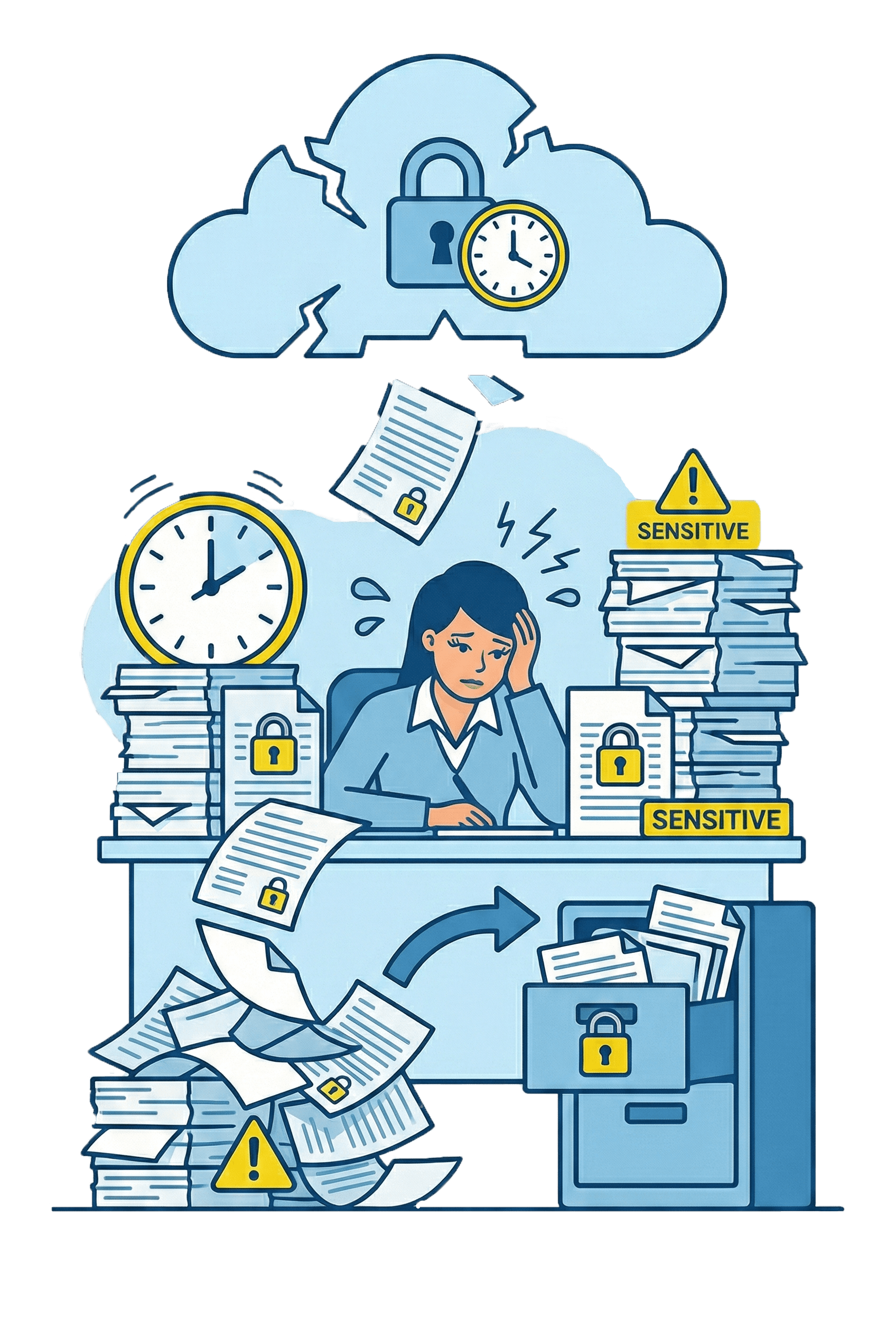
The customer’s challenge: manage large volumes of confidential HR data
Managing HRIS batch outputs at scale
Each payroll cycle generated large batch files containing thousands of payslips.
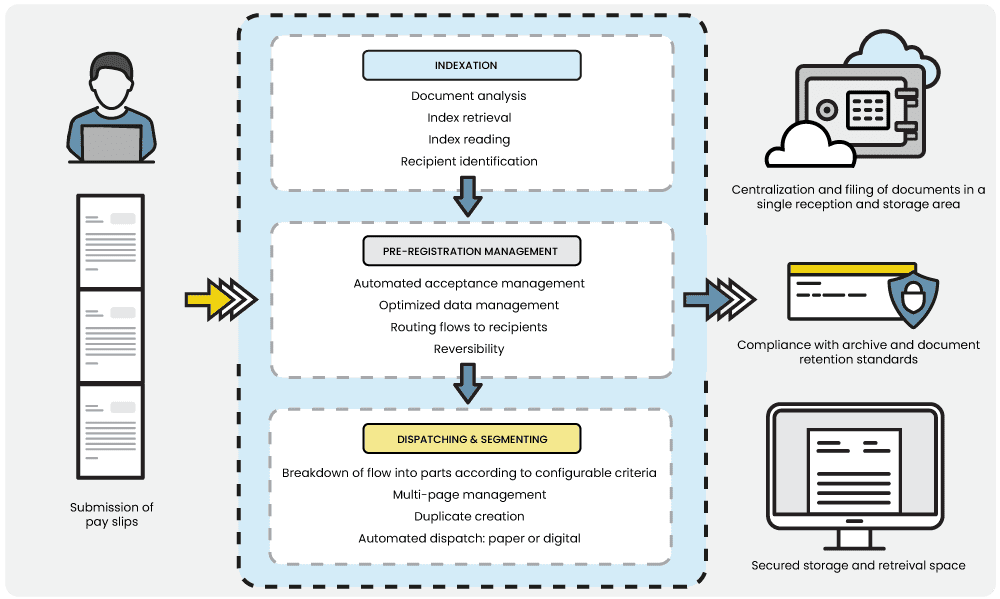
Processing these workflows involved several key steps:
- automated intake from the HR system
- format normalization and conversion when needed
- metadata extraction and indexing
- logical and physical splitting into individual documents
- distribution tailored to each employee’s profile and their preferred delivery method (paper or electronic).
Embedding compliance into the process
In France, the transition to electronic pay stubs is governed by very strict legal and regulatory requirements.
The organization had to guarantee:
- managing agent consent, including opt-in and opt-out mechanisms;
- GDPR compliance
- strict confidentiality and the protection of sensitive HR data
- full traceability of every transaction and every transmission
- alignment with standards such as NF Z42-020 and NF Z42-025
Compliance must be fully integrated and managed throughout the entire process.
Support for multichannel distribution
Most employees agreed to receive their payslips via an electronic safe. However, some employees preferred to continue receiving them in paper form by mail.
It was therefore necessary to implement a centralized solution capable of seamlessly and securely managing both digital and physical routing based on a single stream of payslips.
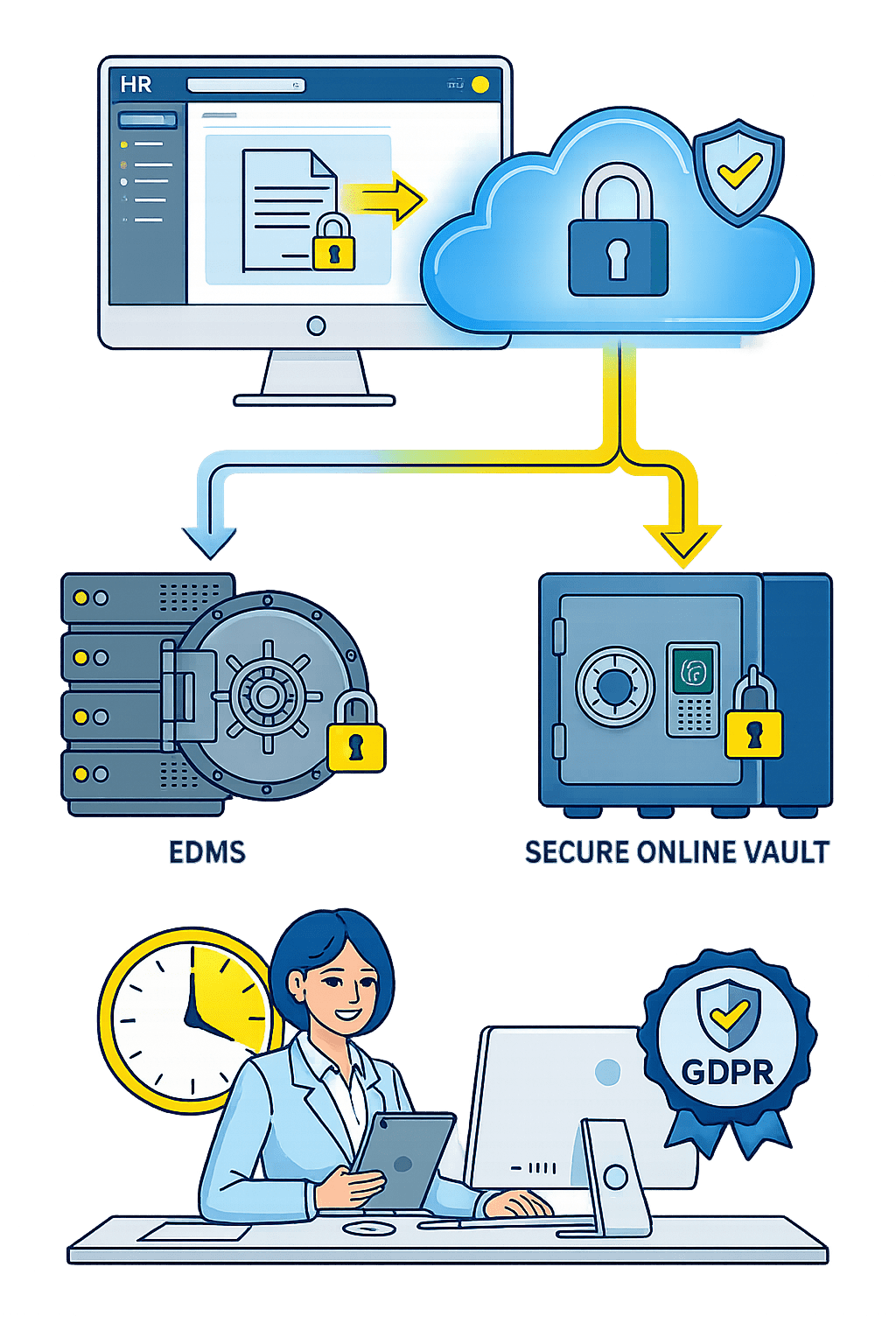
Proposed Solution: Seamless integration with electronic safes thanks to the Scop Software Suite platform combined with the Digiconnect connector.
HR document management solutions were deployed in SaaS mode to manage the entire electronic lifecycle of payslips.
The core objective was automation and governance.
Flexible intake and submission
Payroll outputs are captured directly from the HRIS environment through multiple submission methods:
- virtual printer capture
- web-based upload interface
- batch command-line processing
- API integration with HR systems
This ensures seamless integration without requiring any changes to the existing payroll system.
Intelligent processing: splitting, and indexing
Batch payroll files are automatically processed and split into individual documents.
Each payslip is indexed using extracted metadata and linked to the correct employee. Structured metadata enables precise routing and complete control.
The submission of multiple files is supported if necessary, including index files or structured data accompanying the PDF.
Consent management and validation workflows
Employee eligibility and pre-adhesion rules are automatically verified before distribution.
Configurable validation workflows allow designated HR managers to approve payroll batches before release, reinforcing internal control.
Multichannel routing engine
Once validated, documents are routed automatically based on predefined business rules.
Possible destinations include:
- secure digital vault systems in France or other European countries
- corporate archiving platforms
- employee portals
- certified print and mail centers
The same orchestration engine manages both digital and physical outputs, ensuring consistency and traceability across channels.
Supervision, accounting, and reporting
HR teams gained full visibility of the workflow.
The solution provides:
- real-time status monitoring
- error management and reprocessing capabilities
- accounting of submitted batches
- activity reporting and volume tracking
Every submission, validation, and transmission is logged, ensuring readiness for audits and operational oversight.
Compliance and security by design
The implemented architecture aligns with:
- GDPR data protection requirements
- NF Z42-020 secure electronic archiving standards
- NF Z42-025 trusted digital archiving systems
Security mechanisms include encrypted transmission, role-based access control, integration with LDAP or Active Directory, and controlled authentication including Single Sign-On.
The SaaS architecture operates in segregated environments to ensure strict data isolation.
MPI Tech has more than ten years of experience in high-volume HR document processing for public and private organizations.
Results achieved
The organization achieved measurable transformation.
Printing and mailing costs were significantly reduced.
Payroll distribution became automated, controlled, and traceable.
Manual manipulation of batch files and exception handling were drastically reduced.
HR teams now operate within a governed workflow environment and benefit from full visibility over payroll document workflows.
Employees access their payslips securely through their preferred channel, while the organization maintains complete control of its document governance process.
A scalable model beyond France
Although implemented for a French public organization, the architecture is adaptable to international contexts.
The same approach supports integration with secure digital vault ecosystems in countries such as Denmark, as well as corporate or hybrid distribution environments.
The value proposition remains consistent:
- control the HRIS output.
- automate document processing.
- securely route across digital and physical channels.
- ensure compliance at every step.